
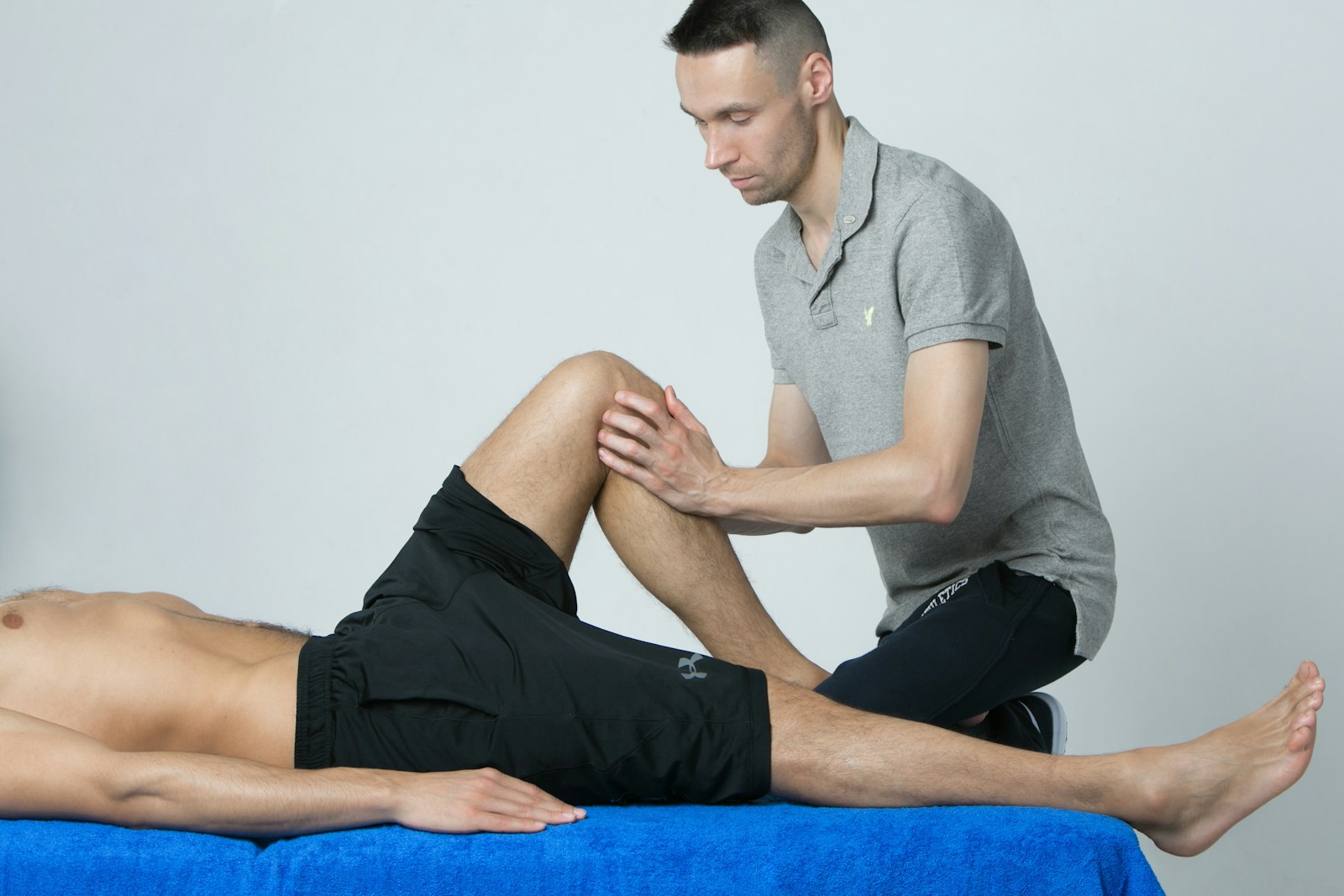
In short — Knee pain is one of the most common reasons for doctor visits, for both athletes and sedentary individuals. The most common causes are Patellofemoral syndrome (pain at the front of the knee, common before age 50), the’Arthritis (after 50 years) and the damage to tendons, ligaments, or menisci. In the vast majority of cases, the management is conservative Exercise and muscle strengthening, particularly of the quadriceps and hips, are currently the standard treatment. At the On Therapy clinic in Grand-Saconnex, care is active and adapted to the origin of the pain and your goals.
Why is the knee a sensitive joint?
The knee is a highly stressed joint: it supports the body's weight and absorbs significant stress with every step, stair climb, or athletic movement. Its stability depends on a delicate balance between the bones, the menisci (shock absorbers), the ligaments (stabilizers), and above all, the musculature the muscles surrounding it — quadriceps, hamstrings, and hip muscles.
It is this muscle balance that explains why strengthening is at the heart of treating most knee pain: a knee that is well supported by its muscles is a better protected knee.
What are the causes of knee pain?
Origins vary greatly depending on age, activity, and context:
- Patellofemoral syndrome Pain at the front of the knee, around the kneecap, common in athletes and before age 50. It is the most frequent diagnosis in young individuals.
- Knee osteoarthritis (gonarthrosis) Cartilage wear, common after age 50, with mechanical pain and stiffness.
- Tendinopathies of the patellar tendon («jumper's knee») or quadriceps tendon, related to overuse.
- Meniscal tears Meniscal tear, traumatic or degenerative.
- Ligament injuries sprain, anterior cruciate ligament (ACL) injury (common in sports).
- IT Band Syndrome Pain on the outer side of the knee, common in runners.
Note: As with the back and shoulder, signs of wear visible on imaging are not always the cause of pain — The correlation between radiographic stage and perceived pain is often weak. Clinical examination remains essential.
What are the symptoms?
Depending on the cause, knee pain can manifest as:
- one Pain in the front from the knee, around the kneecap (typical of patellofemoral syndrome)
- a pain enhanced on the stairs, in a squatting position or after sitting for a long time
- one mechanical pain (triggered by exertion, relieved by rest) in case of osteoarthritis
- one stiffness, especially in the morning or after inactivity
- One swelling or a feeling of instability
- sometimes some blockages or cracking
When should I consult?
Early-diagnosed knee pain generally heals better. Some signs warrant medical advice. fast :
- pain after a severe trauma (torsion, shock, sports accident)
- One Significant and sudden swelling from the knee
- one instability marked, a feeling that the knee «gives way»
- One block knee (impossible to bend or straighten completely)
- one redness, warmth, fever (suspicion of infection)
- intense pain that does not subside
⚠️ If you see these signs, consult a doctor.
Do we need imaging?
Not always. For many knee pains, the diagnostic and clinical. Imaging is useful in certain situations: traumatic context, suspected ligament or meniscus injury, osteoarthritis assessment, or pain resistant to treatment.
In cases of typical osteoarthritis, further examinations are often unnecessary, except in cases of atypical progression or before surgery. Early imaging may reveal common abnormalities with no direct link to the pain.
How to treat knee pain? Movement-based approach
For the vast majority of knee pain, the treatment is conservative (without surgery) and relies primarily on the’exercise. Current recommendations are clear: exercise therapy reduces pain and improves function, in the short, medium, and long term.
An important point, confirmed by recent studies: we must strengthen The knee and the hip, not just the knee. The combination is more effective.
At the On Therapy practice, care is structured around:
| Pillar | What it offers |
|---|---|
| Targeted Reinforcement | Quadriceps and hip muscles (glutes) – the combination is most effective |
| Mobility work | Regain joint amplitude and flexibility |
| Load adaptation | Dose the activities, adjust the sports training, resume gradually |
| Education | Understanding pain, adjusting movements, maintaining physical activity |
Maintaining physical activity is essential, especially in osteoarthritis: movement preserves cartilage and function, while a sedentary lifestyle worsens the situation. Complementary approaches (taping, insoles depending on the case) can be added to the exercise program.
5 Useful Exercises for Knee Pain
These exercises are provided for reference only and should be adapted to your situation. An exercise should not cause sharp pain: if in doubt, ask your physiotherapist for advice.
- Quadriceps strengthening — Sitting or lying down, extend the leg and contract the thigh, holding for a few seconds, to strengthen the muscle that stabilizes the kneecap.
- Glute bridge — Lie on your back with your knees bent, and lift your pelvis to strengthen your glutes, which are essential for proper knee alignment.
- Hip abduction — Side-lying or standing with a resistance band, abduct the leg to strengthen the lateral hip musculature.
- Gentle hamstring and quadricep stretch — to maintain flexibility around the knee.
- Walk or bike Gentle knee activities that maintain mobility without excessive strain.
Golden rule: prioritize gradual and comfortable work. Sharp pain or pain that persists after effort is a signal to adapt.
How long does knee pain last?
| Situation | Usual progression |
|---|---|
| Patellofemoral syndrome | Improvement on several weeks to a few months with a tailored exercise program |
| Tendinopathy | Progressive recovery on several weeks to a few months |
| Arthritis | No cartilage healing, but pain and function are significantly improvable and stabilizable with regular exercise. |
The timeliness and early nature of management are decisive. For femoropatellar syndrome in particular, early active management improves the prognosis and reduces the risk of persistent pain.
How to prevent knee pain?
- maintain the Quadriceps and glute strength
- increase gradually training loads (running, sports), without jolts
- maintain a Regular physical activity, even in case of osteoarthritis
- to ensure a target weight Every kilo less reduces the strain on the knee
- choose good shoes and adjust your sports technique if necessary
- act early on a developing discomfort rather than letting it settle in
Our approach at On Therapy in Grand-Saconnex
At On Therapy, near Geneva, we treat knee pain with an approach active and based on reinforcement. Rather than rest, we prioritize an exercise program targeting the knee and hip, load adaptation, and the gradual resumption of activities and sports.
Each session begins with a precise assessment to identify the origin of the pain and to construct a plan tailored to your goals.
👉 Learn more about our sports physiotherapy in Grand-Saconnex.
To make an appointment · Contact Us
Frequently Asked Questions About Knee Pain
Should a painful knee be rested?
No complete rest. Maintaining appropriate activity and a progressive strengthening program promotes recovery; immobility weakens the muscles that protect the knee.
What sport when you have a sore knee?
Gentle activities like walking, cycling, or swimming are generally well tolerated. The important thing is to adapt the intensity and strengthen in parallel. Your physical therapist can guide you.
Does knee osteoarthritis require stopping sports?
On the contrary: adapted physical activity is one of the best treatments for osteoarthritis. It maintains mobility and reduces pain. The goal is to adapt, not to stop.
Is an MRI needed for knee pain?
Not systematically. Many pain conditions are diagnosed clinically. Imaging is reserved for traumatic contexts, suspected ligament or meniscus injuries, or persistent pain.
Does knee pain require surgery?
Rarely as a first-line treatment. The vast majority of knee pain is treated without surgery through rehabilitation. Surgery is reserved for specific cases.
Is physiotherapy covered for knee pain?
Yes, with a doctor's prescription, covered by basic insurance (LAMal), according to your insurance conditions.
Article written by Yves Burri, physiotherapist at the On Therapy practice (Le Grand-Saconnex, Geneva). Last updated: 06/08/2026. This article is for informational purposes only and does not replace a consultation. In case of pain, consult a healthcare professional.
Sources
- High Authority for Health (HAS) — Patellofemoral Syndrome: Evaluation and Rehabilitative Treatment (2024)
- Recommendations for the Management of Gonarthrosis (SFR)
- ameli.fr (Health Insurance) — Knee Pain



Leave a Reply