
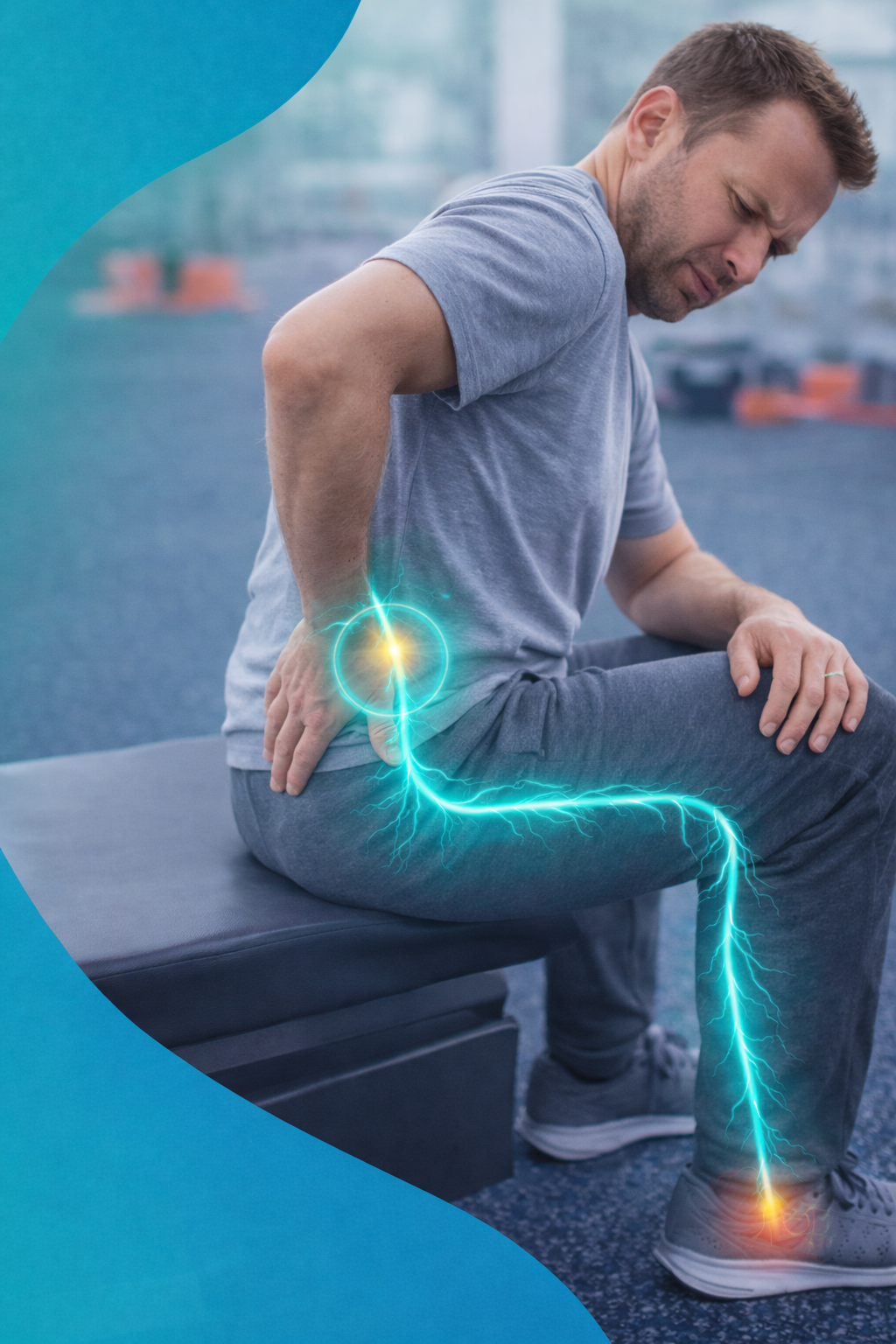
In short Sciatica is pain that starts in the lower back and travels down the leg, most often caused by a herniated disc compressing or irritating the sciatic nerve. It is a common condition and, in the vast majority of cases, benign: most cases of sciatica improve within a few weeks. Active physiotherapy is the first-line treatment: rather than rest, the emphasis is on maintaining movement, targeted exercises, and a gradual return to activities. At the On Therapy practice in Grand-Saconnex, treatment is adapted to the origin of the pain, its duration, and your goals.
What is sciatica?
Sciatica (or lumbosacral sciatica when accompanied by lower back pain) is pain related to the irritation or compression of the Sciatic nerve, the longest nerve in the body. It originates from the nerve roots of the lower spine (mainly L5 and S1) and travels down through the buttock, the back of the thigh, and then into the leg and foot.
The term «sciatica» therefore describes a symptom (pain that follows the path of the nerve), not a disease in itself. Identifying what is irritating the nerve is the key step in management.
What are the symptoms of sciatica?
Sciatica is recognized by pain that follows the path of the nerve, usually on one side:
- pain originating from the lower back or buttock and Go down the leg
- desk tingling, tingling or numbness along the path
- a feeling of burn or electric shock
- sometimes a muscle weakness in the leg or foot
- often a pain augmented due to prolonged sitting, coughing, or sneezing
The intensity varies greatly from person to person, from mild discomfort to severe, debilitating pain.
Sciatica is caused by irritation or compression of the sciatic nerve. This can be due to several factors, including: * **Herniated disc:** This is the most common cause, where the soft inner material of a spinal disc bulges out and presses on the sciatic nerve. * **Spinal stenosis:** A narrowing of the spinal canal, which can put pressure on the nerve roots that form the sciatic nerve. * **Spondylolisthesis:** A condition where one vertebra slips forward over another, potentially impinging on the sciatic nerve. * **Piriformis syndrome:** The piriformis muscle, which is located deep in the buttock, can spasm and irritate or compress the sciatic nerve as it passes nearby. * **Trauma or injury:** A direct blow to the hip or buttocks, or a fall, can injure the sciatic nerve. * **Tumors:** Though rare, a tumor in the spinal canal or pelvis can press on the sciatic nerve. * **Degenerative disc disease:** As discs age and degenerate, they can lose their cushioning ability and lead to nerve compression. * **Pregnancy:** The weight of the uterus can sometimes put pressure on the sciatic nerve.
In young adults (20-40 years old), the most frequent cause is Herniated disc : an intervertebral disc bulges and irritates a nerve root. In older people, it's more the’Arthritis and spinal stenosis (narrowing of the spinal canal) which are the cause.
Other common factors:
- Nerve root compression or irritation
- muscle tension and imbalances
- Lack of mobility and sedentary lifestyle
Known risk factors: smoking, overweight, physically demanding occupations, and sedentary lifestyle.
When should you seek emergency care?
The vast majority of sciatica cases are benign. But certain signs warrant a doctor's visit. fast, because they can indicate a serious condition (including cauda equina syndrome):
- one significant loss of strength or that worsens in the leg or foot
- desk trouble urinating or defecating (incontinence or retention)
- one Loss of sensation in the saddle/groin area saddle block anesthesia
- a pain violent and resistant to any treatment
- of the fever, unexplained weight loss, or a history of cancer
⚠️ If you notice any of these signs, do not wait: contact a doctor immediately.
How is the diagnosis made?
Sciatica is primarily a clinical diagnosis In most cases, the examination is sufficient, without imaging. During the assessment at the office, the physical therapist:
- Reconstitute the history of the pain (onset, location, aggravating factors)
- achieves mobility, strength, and sensitivity tests
- uses specific nerve tension tests to pinpoint the level reached
Imaging (MRI) is only useful in specific situations: signs of severity, persistent pain, or assessment before injection or surgery. An MRI performed too early often reveals abnormalities (hernias, disc wear) that are not necessarily responsible for the pain—hence the importance of the clinical examination.
How to treat sciatica? Step-by-step treatment
The modern approach, recommended by learned societies, favors active movement rather than rest. Prolonged bed rest is now discouraged: it tends to prolong pain rather than relieve it.
At On Therapy, treatment is progressive and adapted to the phase:
| Phase | Objective | Physical therapy approach |
|---|---|---|
| Acute phase (severe pain) | Relieve, reassure, keep moving | Education, positioning advice, gentle mobilization, maintaining tolerable activity |
| Intermediate phase | Restore mobility and desensitize the nerve | Nerve mobilization exercises, postural work, gradual return to activity |
| Consolidation phase | Strengthen and prevent recurrence | Core and hip strengthening, retraining, return to activities and sport |
The goal is not only to relieve the pain, but to process the cause and to restore confidence in the movement.
5 Useful Exercises for Sciatica
These exercises are for guidance only. They should be adapted to your situation If an exercise increases pain in your leg, stop and talk to your physical therapist.
- Two rounds / two hollows («cow-cat») On all fours, gently alternate between arching and hollowing the back to limber up the entire spine.
- Basin tipping — Lie on your back with your knees bent, gently rock your pelvis to mobilize your lower back.
- Child's Pose (yoga) — Seated on your heels, chest relaxed forward, arms extended: a gentle stretch for the lower back that helps release tension.
- Gentle glute stretch — bring a knee to your chest, without forcing.
- Steady walk — one of the best activities: it maintains mobility without overloading the back.
⚠️ Golden rule: an exercise that increase the pain in the leg It must be stopped. Mild back discomfort may be tolerable, but radiation into the leg is a warning sign.
How long does sciatica last?
The duration varies greatly from person to person. Some general guidelines:
| Situation | Usual progression |
|---|---|
| Acute simple sciatica | Nice improvement in 2 to 6 weeks in the majority of cases |
| More stubborn cases | Possible solution for several months |
| Chronicity | Environment 20 to 30 % sciatica becomes chronic |
The more comprehensive the coverage is early and active, ...the faster and more complete the recovery tends to be. Waiting for "it to go away on its own" carries the risk of the condition becoming chronic.
How can you prevent a recurrence?
Once the crisis has passed, prevention hinges on maintaining a flexible and strong back:
- Move regularly, avoid prolonged sitting
- strengthen your core and hips
- pay attention to work postures (sitting, lifting)
- maintain a regular and appropriate exercise routine
- act early on initial discomfort rather than waiting
Our approach at On Therapy in Grand-Saconnex
At On Therapy, just outside Geneva, we treat sciatica using an approach active and movement-based. Rather than prescribing rest, we support a gradual and safe return to activity by combining education, neuromuscular mobility, strengthening exercises, and a return to sports when appropriate.
Each session begins with a precise assessment to identify the origin of the pain and to construct a plan tailored to your goals.
👉 Learn more about our sports physiotherapy in Grand-Saconnex.
To make an appointment · Contact Us
Frequently Asked Questions About Sciatica
Should you rest or stay active if you have sciatica?
It’s better to stay active. Prolonged bed rest is no longer recommended: staying active at a level appropriate for your pain promotes better recovery.
Is walking good for sciatica?
Yes, in most cases. Regular walking keeps you mobile without overtaxing your back and is one of the recommended activities, unless your therapist advises otherwise.
Should you get an MRI for sciatica?
Not always. Sciatica is diagnosed clinically. MRI is reserved for severe cases, cases that do not respond to treatment, or prior to an injection or surgery.
How many physical therapy sessions are needed for sciatica?
It depends on how long the condition has been present and how severe it is. Many cases improve within a few sessions, while others require longer-term treatment. A treatment plan is established following the initial assessment.
Does sciatica require surgery?
Rarely. The vast majority of sciatica cases are treated without surgery. Surgery is considered only in cases of severe symptoms or failure of a well-managed conservative treatment.
Is physical therapy covered for sciatica?
Yes, with a doctor's prescription, covered by basic insurance (LAMal), according to your insurance conditions.
Article written by Patrick Berret, physical therapist (HES) at On Therapy (Le Grand-Saconnex, Geneva). Last updated: [06/02/2026]. This article is for informational purposes only and does not replace a consultation. If you are experiencing pain, consult a healthcare professional.
Sources
- French National Authority for Health (HAS) — Management of patients with common low back pain
- ameli.fr (Health Insurance) — Sciatica: Consultation and Treatment
- NICE Guidelines – Low Back Pain and Sciatica
- MSD Manuals - Sciatica




Leave a Reply